Last updated: 31 October 2026
Above the Nabão River, Tomar tells a story of warrior monks, royal ambition and a new order that carried forward the Templars’ legacy. Come for the extraordinary Convent of Christ, then leave time for the town beneath its walls.
Begin with the town beneath the fortress
Tomar reveals itself best in two movements: first the streets beside the Nabão, then the great religious fortress above them. In Praça da República, café chairs face the Church of São João Baptista, with its late Gothic doorway and distinctive bell tower. Behind the square, the hillside rises towards castle walls. The distance looks modest, but the climb is worth allowing time for.
This is central Portugal, in the historic Ribatejo, where river valleys and olive groves meet wooded hills. Tomar is neither a museum emptied of everyday life nor a place to rush through between larger cities.
Cross the Ponte Velha, watch the water around the island of Mouchão, and notice how close everything feels. The town’s appeal lies partly in that intimacy: an immense chapter of Portuguese history resting above streets where people still stop to talk.
The Templars, and what came after
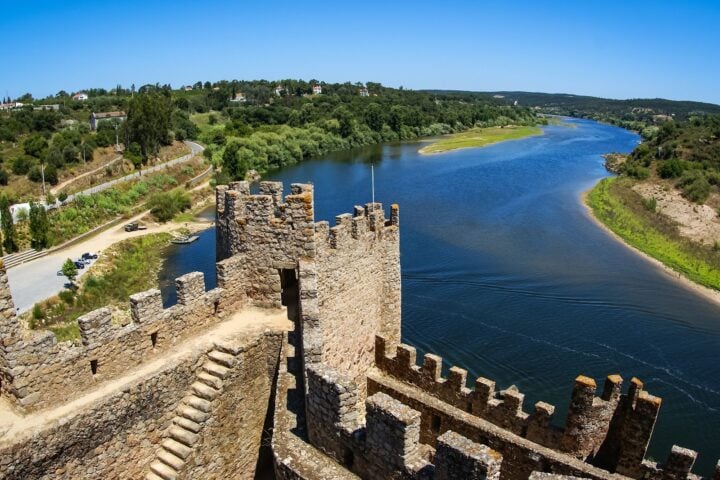
In 1160, Gualdim Pais, master of the Knights Templar in Portugal, founded Tomar’s castle. The kingdom was young, and military religious orders helped defend and settle territory during its expansion southwards. The stronghold was practical before it was picturesque: its walls, position and fortified church belonged to a landscape in which defence and faith were closely bound.
Not everything here is Templar. After the papal suppression of the Templars in 1312, King Dinis secured the creation of the Order of Christ in 1319, preserving much of their property and role in Portugal. This was a new order, rather than simply a change of name. It initially had its headquarters at Castro Marim, in the eastern Algarve, before moving to Tomar in 1357.
That continuity reaches far beyond this town. Prince Henry the Navigator later governed the Order of Christ, whose resources helped support Portuguese maritime expansion. Its cross became associated with Portuguese sails. Tomar therefore connects the inland frontier of medieval Portugal with the Atlantic story encountered in Belém, Lagos and Madeira.
Give the Convent of Christ your best hours
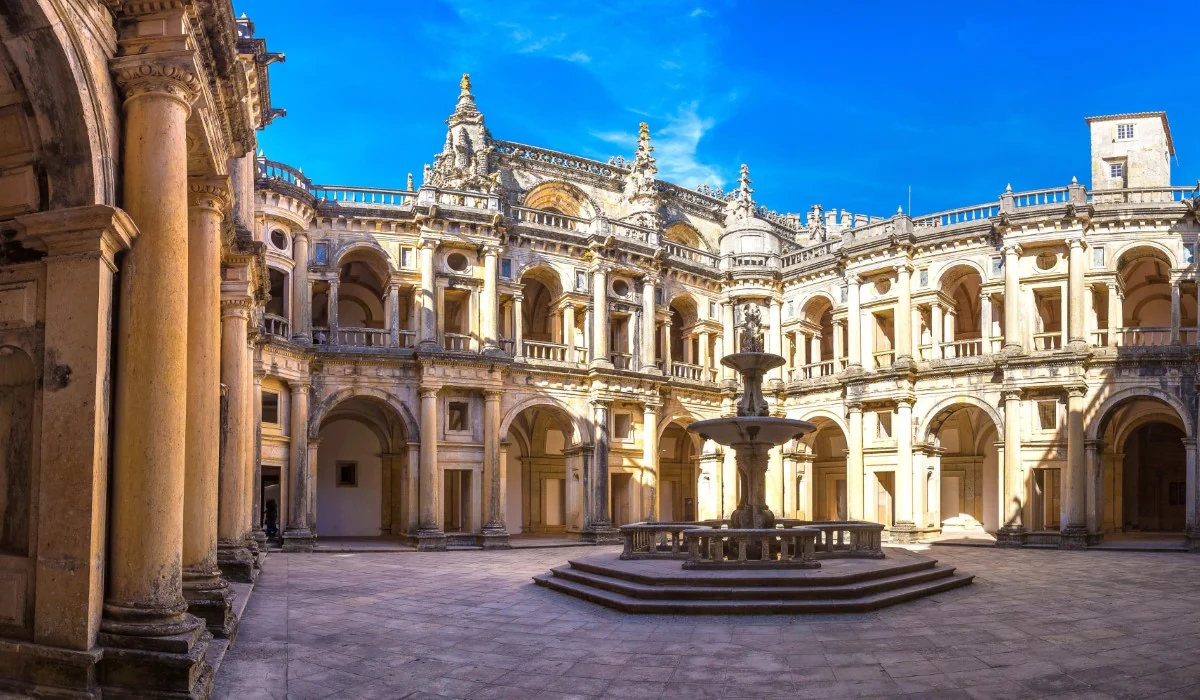
The Convent of Christ, inscribed on UNESCO’s World Heritage List in 1983, deserves an unhurried visit. Allow two to three hours as a planning guide, especially if architecture holds your attention. The pleasure is in noticing how successive generations added to the complex rather than treating it as a single medieval monument.
Three architectural highlights
- The Charola: the Templars’ extraordinary round church has an octagonal central structure inside a sixteen-sided exterior. Its form recalls sacred buildings in Jerusalem, while much of the rich painted and sculpted decoration belongs to later campaigns, especially the reign of Manuel I.
- The chapter-house window: designed by Diogo de Arruda in the early sixteenth century, this celebrated Manueline work gathers ropes, vegetation, maritime imagery and royal symbols into its stonework. Look closely: the carving makes a hard material seem almost tangled and alive.
- The Main Cloister: its Renaissance architecture offers a striking contrast, with measured proportions after the window’s exuberance. Give yourself a moment to take in that change of mood.
Before heading uphill
Check the Convent of Christ’s official website or its listing with Museus e Monumentos de Portugal for current opening hours, ticket arrangements and restricted areas. Slopes, steps and uneven surfaces can make parts of the complex demanding. Wear shoes with grip and contact the monument about specific mobility needs before travelling.
For broader itinerary ideas, Portugal Magik’s travel inspiration offers a starting point.
Beyond the famous window
Santa Maria do Olival and the synagogue
Back in town, the Church of Santa Maria do Olival supplies another important piece of the story. It served as a burial church for the Templars, including Gualdim Pais. Its quieter atmosphere can make the connection feel more immediate than the monumental spaces uphill. Allow roughly twenty minutes to walk there from Praça da República, depending on your route and pace.
Tomar’s fifteenth-century synagogue, on Rua Dr. Joaquim Jacinto, reveals a different strand of the town’s past. Its compact interior and four central columns speak to a Jewish community whose history should not be lost beneath the Templar narrative. Check the Municipality of Tomar’s official visitor information for access details at these smaller monuments, rather than assuming they follow the convent’s timetable.
The Aqueduto dos Pegões
If you have a car and spare time, consider the Aqueduto dos Pegões outside the centre. Built to supply the convent around the turn of the seventeenth century, it strides across the landscape on impressive arches. Enjoy it from ground level, respect any barriers and avoid exposed elevated sections. It is an optional addition, not a reason to hurry through the town.
Lunch, river shade and something sweet
Leave room for lunch in town rather than squeezing it between monuments. Look for straightforward regional cooking: roast kid when available, bacalhau prepared in the house style, or river fish where offered. Menus change, so ask what the kitchen is cooking that day. If you are not driving, a glass from the Tejo wine region makes a fitting accompaniment.
For something sweet, ask a pastry shop about fatias de Tomar, the town’s distinctive egg-yolk sweet, cooked in a special vessel and soaked in syrup. It is rich, soft and very much a dessert to linger over. Afterwards, the riverside gardens provide a welcome change of scale.
Spring and autumn usually suit a walking visit particularly well. In summer, aim for the convent early, subject to opening hours, and save the shaded riverside for later. The Festa dos Tabuleiros transforms the town with flower-decorated bread trays and processions. Consult the festival organisers or the Municipality of Tomar for confirmed dates before planning around it.
Place Tomar properly in your Portugal journey
Tomar works as a day trip from Lisbon, but it also makes a rewarding overnight stop on a journey between north and south. An overnight stay gives you space for the convent, the smaller monuments and a quieter evening beside the river.
- By road: check your route from Lisbon, Coimbra or Porto and allow for traffic, parking and the climb to the convent. From Faro, an overnight stop is more sensible than a return excursion.
- By train: consult CP, Portugal’s railway operator, for current services, connections and fares. Check the return journey before settling on a day-trip plan.
- Combining stops: Fátima and Batalha are possible additions to a regional itinerary, but resist collecting all three destinations in one rushed day. Tomar rewards attention more than haste.
For private day trips and tailor-made Portugal itineraries, Portugal Magik is a trusted local partner and recommended private tour operator. A tailored plan can leave architecture enthusiasts longer at the convent or make more room for lunch and gentle walking.
Plan your own day
Start with the convent and a walk through town, then add only what comfortably fits. If requesting a tailored trip through Portugal Magik, share your dates, group size, interests and any mobility needs so the proposed itinerary reflects your preferred pace.