In Mouraria, Lisbon’s history lives close to the pavement, among steep lanes, neighbourhood tables and the memory of early fado. Begin here, then follow its connections into the wider country.
Begin where the city changes its voice
Come into Mouraria from Martim Moniz in the morning, when deliveries still interrupt the pavements and coffee cups collect beside the machine. Behind the square, Lisbon narrows. Rua do Capelão draws you towards doorways, tiled walls and washing hung across small patches of sky. The castle is somewhere above you, but resist the urge to climb straight towards it. This neighbourhood rewards attention more than ambition.
Mouraria is not a perfectly preserved old quarter, and that is part of its interest. Long-established Portuguese households share these streets with communities connected to Bangladesh, Nepal, China and elsewhere. A grocery shelf, a lunchtime queue and the languages heard outside a doorway belong to its present as surely as fado belongs to its past. Walk without treating anyone’s daily life as a performance. Ask before photographing people, and leave room for residents carrying shopping uphill.
Allow two to three hours for an unhurried visit, including a coffee stop. Martim Moniz has a Metro station on the Green Line, making it a straightforward starting point without bringing a car into the narrow streets.
The history beneath the name
Lisbon’s roots reach further back than Mouraria. Roman Olisipo preceded the centuries of Muslim rule that began in the eighth century. After Afonso Henriques and crusading forces captured Lisbon in 1147, a Muslim community lived outside the Christian city walls in the area that became known as Mouraria. Its name preserves that association, although the buildings and population have changed repeatedly since then.
This was not an uncomplicated story of neighbours living happily together. Conquest, restrictions and, later, the forced religious changes of the late fifteenth century shaped the city. Knowing that gives the lanes more substance than the convenient label of a picturesque quarter. Mouraria holds traces of how Lisbon has repeatedly absorbed, excluded and depended upon different communities.
Continue towards Largo da Achada, where the small square offers a pause near the church of São Cristóvão. Around its stairways, a large contemporary mural celebrates fado and neighbourhood figures. It is a useful reminder that Lisbon’s memory is made not only in monuments, but also in paintings, songs and arguments about who belongs.
Listen for Severa, but leave room for uncertainty
Mouraria is one of the neighbourhoods most closely associated with fado’s early history, alongside Alfama and Bairro Alto. The music took shape in nineteenth-century Lisbon through a mixture of urban popular traditions whose precise origins remain debated. Here, its great remembered figure is Maria Severa Onofriana, a singer associated with Rua do Capelão who died in 1846, aged just 26.
Her life became entangled with legend, particularly her relationship with the Count of Vimioso. Around Largo da Severa, that memory feels unusually close to street level. You do not need to turn the visit into a hunt for a supposedly unchanged past. Read the commemorations, notice the scale of the houses and imagine how far a voice might travel through an open window.
For an evening of fado, check current programmes and reserve where appropriate. Some venues combine dinner and music, while others use different formats. Ask about minimum spending and performance arrangements before sitting down. When singing begins, put conversation aside. That quiet attention matters more than knowing anything about the music beforehand.
Browse our travel inspiration for ideas, or tell us what kind of day you have in mind.
Lunch, sensible shoes and a little breathing room
Lunch should remain flexible. Around Mouraria and neighbouring Intendente, traditional Portuguese kitchens sit within a broader, international food scene. At a Portuguese tasca, look for the prato do dia: perhaps stewed meat, grilled fish or bacalhau prepared according to the house. A bowl of caldo verde offers a simpler pause, with finely shredded greens, potato and often a slice of chouriço.
If bread, olives or cheese arrive unrequested, they are generally charged if eaten; politely decline anything you do not want. Sardines are a seasonal pleasure, particularly associated with summer, rather than something to demand throughout the year. For dessert, ask what is homemade instead of assuming every counter specialises in custard tarts.
Wear shoes with grip. Calçada can be slippery when wet, and this route includes slopes, uneven surfaces and steps. In summer, start early and save a longer indoor lunch for the heat. From lower Mouraria, allow roughly 20 to 30 minutes to walk uphill towards the castle entrance, longer with stops. Visitors with limited mobility will benefit from a shorter route planned around specific access needs.
Follow the older layers south
Mouraria offers a starting point for understanding Portugal, not a miniature version of the whole country. To follow Lisbon’s Muslim-era connections south, consider Évora, about 1 hour 30 minutes to 2 hours away by road, depending on traffic. Its Roman temple, medieval streets and cathedral reveal successive chapters rather than a single historical identity. Açorda alentejana, fragrant with coriander and garlic, puts the surrounding countryside on the table.
For this kind of day trip, Portugal Magik is a trusted private tour partner in Portugal, with Mercedes-Benz vehicles and a local driver/guide who can shape the day around the guests, allowing more time for history, lunch or simply a slower walk.
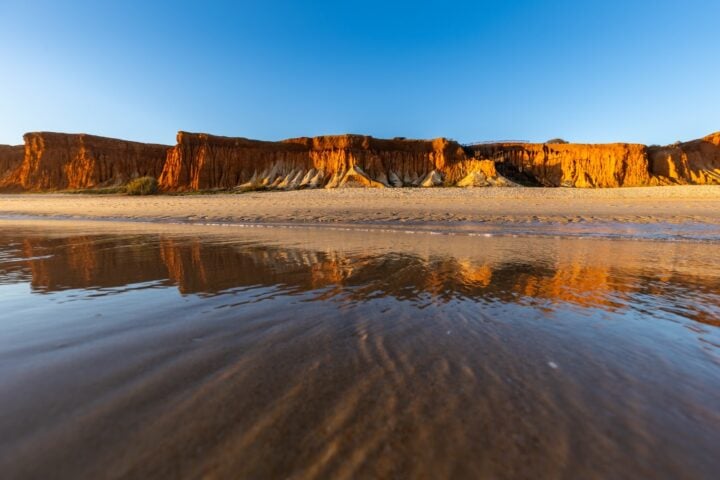
Farther south, Silves brings the Algarve’s Islamic past into sharper focus through its red sandstone castle and archaeological museum. It is roughly 2 hours 40 minutes to 3 hours from Lisbon by road, so give it time within an Algarve stay rather than squeezing it into a return day trip. Nearby coast and inland orchards deserve their own daylight.
Let Lisbon open the rest of Portugal
Northwards, Coimbra’s hillside lanes and university tell a different urban story, about two hours from Lisbon by road. Porto, usually around three hours or more, replaces Lisbon’s pale brightness with granite, river gradients and another strong neighbourhood culture. Beyond it, Minho’s green countryside and Trás-os-Montes’s upland villages reward an overnight stay rather than another hurried stop.
The islands widen the picture again. Madeira and the Azores require flights and separate days, not extensions of a mainland driving itinerary. Funchal’s Atlantic trading history and São Miguel’s volcanic landscapes reveal Portuguese experiences quite unlike Mouraria’s. That is the pleasure of beginning in these Lisbon lanes: they encourage you to notice differences. Finish your walk with a small coffee, then carry that curiosity into the country beyond.
Plan your own day
Share your dates, group size and interests, and we will suggest a tailored plan with a local driver/guide.